
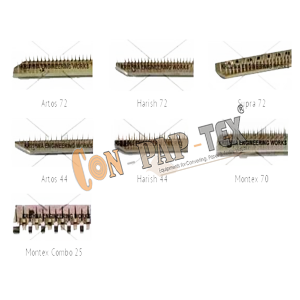
Stenter Pin Bar Replacement
Stenter pin bar replacement means taking a worn pin bar off the stenter chain and fitting a new bar of the same type, so the fabric edge is pinned evenly again. Con-Pap-Tex supplies hardened and hard chrome plated replacement pin bars to suit all makes of stenter machine, and has supplied pin bars and pin plates for the last 25 years.
When does a stenter pin bar need replacing?
A stenter pin bar needs replacing when it can no longer hold the selvedge cleanly and repinning alone will not put it right. Pins wear on every bar, but a bar is only finished when the part that carries the pins is worn too. Look for these signs during a slow walk of the chain at a planned stop:
- The pin block is cracked, chipped or broken at one end.
- The bar sits lower, higher or at an angle compared with its neighbours, although its fixings are tight.
- The fixing holes or seats are worn, so the bar rocks on the chain link.
- The block has been distorted by heat and no longer lies flat.
- Pins are worn on so many bars in one section that replacing whole bars is quicker than repinning them.
A bar with sound block and worn pins does not need replacing. It can be repinned with new pin plates, as described on the stenter repinning page. A bar with a worn block but serviceable pins may need only a new block, covered on the stenter pin block replacement page.
Repin, replace the block or replace the bar?
The choice depends on which part of the bar is worn and on how much time the stop allows. The table gives the usual decision.
| What is worn | Usual action | Why |
| Pins only | Repin with new pin plates | The block is sound, so only the wearing part is renewed |
| Block only | Replace the block | New block, existing pins or new plates as needed |
| Pins and block | Replace the bar | Renewing both parts separately costs more fitting time |
| Most bars in a long section | Replace bars in a planned batch | One stop renews a whole zone of the chain |
| Bar loose although block and pins are sound | Check the chain link first | A worn link makes a good bar rock |
When bars are loose, always check the link before changing the bar. A new bar on a worn link soon works loose again. The stenter chain link bottom parts page explains how to spot link wear.
How are replacement pin bars built?
A replacement pin bar from Con-Pap-Tex is hardened and hard chrome plated, and is carried on a pressure die cast aluminium alloy pin block. Each part of that build has a job in the life of the bar.
Hardening makes the pins resist bending and blunting as they enter the cloth thousands of times a shift. Hard chrome plating gives a hard, smooth surface that resists wear and corrosion from wet fabric and finishing chemicals, and makes deposits easier to clean off. The aluminium alloy block is light, so the chain carries less weight around the machine, and the die cast form keeps blocks of one type alike, so a replacement sits at the same height as the bars around it.
The range covers bars listed as 44 pin and 72 pin and bars for all makes of stenter machine. Pin types, pin counts and how to choose them for a new fabric are explained on the stenter machine pin bar site. This page is about matching a replacement to the bar you already run.
Which stenter makes are replacement pin bars supplied for?
Replacement pin bars are supplied to suit these 20 stenter makes: Artos, Dhall, Harish, Harish Supra, Yamuna, Hi-Tech, S.M., Montex, Swastik, Bruckner, Babros, Ambika, Primatex, Krantz, Bharat Eng, Monforts, Wakayama, Famatex, Stenmech Lucy and James Farmer Norton.
These are the machine makers’ names. The bars are made to suit those machines and are not original parts of the machine makers. If your stenter is not listed, send a sample bar: special types can be matched to a sample.
How to identify a stenter pin bar for replacement
Identify a replacement bar from a good bar on your own chain, never from a worn one. Worn pins are shorter and bent, and a worn block has lost its true shape. Follow these steps:
- Note the stenter make, model and, if known, the year the chain was fitted or last renewed.
- Take one good bar off the chain, or photograph it on the chain from the top and from the side with a ruler beside it.
- Count the pins on the bar and note whether they stand in one row or several.
- Note how the bar fixes to the link: the number and position of fixing points.
- Check whether the chain carries pins only, or pins and clips in alternating sections.
- Count how many bars are worn and in which sections of the chain, so the order covers the whole replacement batch.
With these details the replacement bar can be matched to the bars already on the chain. Matching matters because new and old bars run side by side, and a bar that stands taller or shorter than its neighbours marks the selvedge.
How should a set of pin bars be replaced?
Replace pin bars in planned batches, section by section, at scheduled stops instead of one bar at a time during breakdowns. A batch approach keeps the pin line even and lets the maintenance team work through the chain in order.
- Walk the chain at a stop and mark every bar that needs replacing, with chalk or a paint marker.
- Order the replacements with a small reserve for bars found damaged during fitting.
- At the next stop, clean each link seat before fitting the new bar. Old deposits under a bar lift it out of line.
- Fit the bars and tighten the fixings evenly. A bar that is tight at one end and loose at the other sits at an angle.
- Turn the chain slowly by hand or at crawl speed and look along the pin line from the end of the machine. The tips should form a smooth line.
- Run a trial piece and watch the selvedge go onto the new section at the entry.
If many bars are damaged in the same place on both chains, the cause is usually at the entry: a pinning brush set too deep, a guider fault or a fabric jam. Find that cause before fitting new bars, or the new bars will be damaged the same way.
How long do replacement pin bars last?
The life of a pin bar depends on the fabric, the chemicals and the care it gets, not only on the bar. No fixed figure applies. Bars on a stenter running abrasive, heavy or chemically finished fabric wear faster than bars running plain light cotton, and bars that are cleaned and inspected at every stop last longer than bars that are left until the selvedge starts to fail.
The most useful habit is to record each replacement batch: the date, the section of chain and the reason. After a few batches the record shows how fast your bars wear on your fabrics, and spare stock can be planned from your own figures. The care routine on the stenter pin bar home page is a good starting point.
What to send for a pin bar replacement quotation
A replacement pin bar is quoted from your existing bar. Send the following:
- Stenter make and model, and whether the chain carries pins only or pins and clips
- Photographs of one good bar from the top and from the side, with a ruler
- The pin count on the bar and the number of rows
- How the bar fixes to the link
- A sample bar, if the type is special or not listed above
- The number of bars needed, and whether pin plates or blocks are needed as well
Send these details through the contact page. The other parts that usually come up in the same order, such as links and wheels, are listed on the stenter pin bar spare parts page, and the complete stenter range is on the group’s stenter spares page.
Frequently Asked Questions
What are the signs that a pin bar must be replaced?
A pin bar must be replaced when its block is cracked, distorted or worn at the fixing points, so that the bar sits out of line even with tight fixings. Worn pins alone are not a reason to replace the bar, because they can be renewed by repinning. Bars that are worn in both pins and block are usually replaced whole.
Do replacement pin bars need to match the old bars exactly?
Replacement pin bars should match the bars already on the chain in pin count, height and fixing, because new and old bars run side by side. A bar that stands taller or lower marks the edge and can tear light fabric. Always measure and photograph a good bar from your own chain before ordering.
Why are replacement pin bars hard chrome plated?
Replacement pin bars are hard chrome plated because the plating gives a hard, smooth surface that resists wear and corrosion. Pins work in heat, against wet fabric and finishing chemicals, and the plating slows the roughening that tears selvedges. A smooth surface also releases baked deposits more easily during cleaning.
Can replacement pin bars be supplied for any stenter make?
Pin bars are supplied to suit all makes of stenter machine, including Harish, Dhall, Yamuna, Artos, Bruckner, Monforts, Krantz and many others. For a make that is not listed, send a sample bar and a photograph. The bars are made to suit those machines and are not original parts of the machine makers.
Should all pin bars be replaced at the same time?
Pin bars do not have to be replaced all at once. Most mills replace them in planned batches, section by section, as inspection finds worn bars. A full set change makes sense when most bars on the chain are worn, because one long stop then costs less than many short ones.
Why do new pin bars get damaged quickly?
New pin bars are damaged quickly when the cause of the old damage is still there. A pinning brush set too deep, a cloth guider fault or repeated fabric jams at the entry bend new pins as fast as old ones. Find and correct the cause at the entry before or while fitting the new bars.
Comments are closed.