
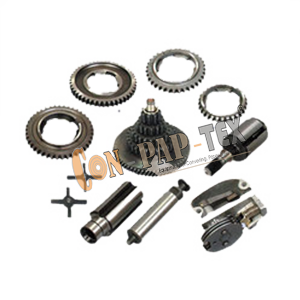
Stenter Gear Box Parts for the Pin Chain Drive
Stenter gear box parts are the gears, sprockets and pulleys in the stenter drive and chamber that turn the chain wheels and move both pin chains at the set speed. Con-Pap-Tex manufactures and supplies stenter chamber and gearbox parts and assemblies, including spur, helical and worm gears, made to the customer’s requirement. Worn drive parts make the pin chains run unevenly or out of step.
What do gear box parts do in a stenter?
The stenter drive turns the chain wheels at the delivery end, and the chain wheels pull both pin chains and the fabric through the chamber. Between the motor and the wheels, a gearbox reduces the speed and shares the drive between the left and the right chain. Other gear sets move the rails in and out to set the width, and drive the overfeed at the entry.
For pinning quality, the drive matters because both chains must move at exactly the same speed, without jerks. The pins on the left and the right chain hold the two edges of the same fabric. If one chain runs even slightly behind, or the chain speed pulses, the fabric is pulled out of square and the pins are loaded unevenly.
Which gear box parts are supplied?
Con-Pap-Tex supplies the following gear and drive parts for stenters and other textile machinery:
| Part | Where it is used in general practice |
| Spur gears | Parallel shafts in the main drive and in width setting |
| Helical gears | Parallel shafts where smoother, quieter running is wanted |
| Worm and worm wheel | Large speed reduction, often in width adjustment drives |
| Rack and pinion | Straight line movement, for example of rails or frames |
| Internal and external ratchet | One way movement and indexing |
| Sprockets and chain sprockets | Chain drives between shafts |
| Timing belt pulleys | Belt drives that must keep exact timing |
| Elevator gearbox | Lifting and lowering movements |
| Chamber and gearbox assemblies | Complete gear assemblies for the stenter chamber and drive |
Gears and assemblies are made to the customer’s requirement, so an existing part can be matched from a sample or a drawing. The basic forms are described under gear and worm drive.
How does drive wear show up at the pins?
Drive wear shows up as pinning faults that affect a whole chain or both chains, not particular bars. The table lists the common signs.
| What you see | Likely drive cause | First check |
| Fabric skewed, weft lines out of square | Left and right chains not in step | Drive to both sides, chain wheels, chain stretch |
| Pinning depth pulses along the length | Chain speed pulsing from worn teeth or play | Gear teeth, couplings and backlash |
| Knocking or noise from the drive | Worn or damaged teeth, worn bearings | Gearbox inspection at a stop |
| Width drifting during a run | Worn width setting gears or screws | Width drive, worm and worm wheel |
| Overfeed drifting from its setting | Worn gears or belts in the overfeed drive | Overfeed drive parts |
| Pin blocks cracking without a clear cause | Jerky chain movement, shock loads | Drive smoothness and chain wheels |
A pinning fault that repeats at the same point of each chain revolution comes from a bar or a link, not from the drive. A fault that runs the whole length of the fabric, or affects one complete side, points to the drive or the feeding. The stenter pin bar replacement page explains how to tell a bar fault from these.
How to check the stenter drive for wear
Check the drive at planned stops, following the stenter maker’s instructions for your model.
- Listen to the drive while running. Note any knocking, whining or change in sound.
- Compare the speed of both chains. Mark a bar on each chain at the entry and watch whether the marks reach the delivery end together.
- Stop and isolate the machine before opening any gear case.
- Inspect the gear teeth for pitting, chipping, uneven wear and wear on one face only.
- Check the backlash in each gear pair by rocking it by hand. Play that has grown over time means worn teeth or bearings.
- Check the sprockets and timing belt pulleys for hooked teeth and worn belts.
- Check the lubricant level and condition, following the maker’s instructions.
- Check the stenter chain wheels at the same time, because they share the load with the drive.
Why does drive wear damage pin bars and blocks?
Drive wear damages pin bars and blocks because it turns a smooth chain movement into a jerky one. Each jerk passes through the chain to the links and the bars, and the bars feel it most as they pass the chain wheels and the pinning brush. Over months, fixings work loose and blocks crack.
If pin blocks keep cracking across the chain with no other cause found, check the drive and the chain wheels before replacing more blocks. The stenter pin block replacement page lists the block faults that point to a cause outside the bar. Worn chain links make the same problem worse, as described on the stenter chain link bottom parts page.
Which stenter makes are gear box parts supplied for?
Gear box parts are supplied to suit these stenter makes: Artos, Dhall, Harish, Harish Supra, Yamuna, Hi-Tech, S.M., Montex, Swastik, Bruckner, Babros, Ambika, Primatex, Krantz, Bharat Eng, Monforts, Wakayama, Famatex, Stenmech Lucy and James Farmer Norton.
These are the machine makers’ names. The parts are made to suit those machines and are not original parts of the machine makers. The sister site’s stenter machine gear box parts page names some of the gear sets used on common stenters.
Ordering gear box parts to sample
Gear box parts are usually ordered to a sample or a drawing, because gears differ between makes, models and even machine builds. The more the order says about the part and its mate, the better the match.
- Send the worn gear, or a drawing, together with its mating gear if possible.
- Count the teeth and note the type: spur, helical, worm, bevel or other.
- Note the bore, the keyway or spline, and how the gear fixes to the shaft.
- Note the position in the machine: main drive, width setting, overfeed or chamber.
If the shaft under the gear is worn, the new gear will not run true. The stenter machine shaft page covers shaft checks.
What to send for a gear box parts quotation
Send the following details:
- Stenter make and model, and the position of the part in the machine
- The part type, the number of teeth and any marking on it
- Photographs of the part and its mounting, with a ruler
- A sample part or a drawing
- The number of parts needed, and whether the mating gear is needed too
Send these details through the contact page. Pin bars, chain parts and other spares for the same stop are listed on the stenter pin bar spare parts page.
Frequently Asked Questions
How do worn stenter gears affect the fabric?
Worn stenter gears make the chain speed pulse or let the two chains run out of step. The fabric is then pinned at uneven depth along its length, or pulled out of square so the weft lines skew. Worn width setting gears let the width drift during a run. All of these look like pinning faults.
How can I tell if the two stenter chains are out of step?
Mark one pin bar on each chain at the entry, at the same moment, and watch the two marks travel to the delivery end. If one mark arrives before the other, the chains are out of step. Check the drive to both sides, the chain wheels and the chain stretch to find the cause.
Which gears are supplied for stenter machines?
Con-Pap-Tex supplies spur gears, helical gears, worm and worm wheel, rack and pinion, internal and external ratchets, sprockets and timing belt pulleys, along with stenter chamber and gearbox parts and assemblies. Gears are made to the customer’s requirement, so a worn gear can be matched from a sample or a drawing.
Why order a gear together with its mating gear?
A worn gear has usually worn its mating gear too, because the two run together. A new gear meshed with a worn partner runs noisily and wears quickly. Send both gears as samples, or at least photographs of both, and renew the pair when the mating gear also shows wear.
Can drive problems crack stenter pin blocks?
Drive problems can crack stenter pin blocks when the chain moves in jerks instead of smoothly. Each jerk passes through the links to the bars, especially at the chain wheels. If blocks crack all over the chain with no clear cause, check the drive and the chain wheels before ordering more blocks.
What information identifies a stenter gear for replacement?
A stenter gear is identified by the stenter make and model, its position in the machine, its type, the number of teeth, the bore and the way it fixes to the shaft. A sample or a drawing gives the most reliable match. Photographs with a ruler help when the part cannot be removed before ordering.
Comments are closed.